Thursday, October 29, 2015

11 Reasons Why Seniors Should Care About #Social #Media

WRITTEN BY: GUEST CONTRIBUTOR - MAR• 05•12

Senior citizens are the fastest growing demographic on Facebook, and this doesn’t surprise me. Though I’m not a senior, I personally use social media tools for business, but also to keep up with past and present friends as well as my family. For seniors, using Facebook, has enabled them to get in touch with long lost friends and relatives, see pictures of grandchildren, and learn more about the brands and causes that mean something to them. But there’s more to social media than Facebook and more to senior citizen use than a few family pictures.
I think there’s this myth that anyone over 50 is technically inept, but I don’t believe this is true. Perhaps many seniors might not be as technically savvy as the younger generation but I don’t think all of them are clueless when it comes to laptops and gadgets. Indeed, my own mother who retired at 70 ,designed online courses for accountants and telecommuted for several years. She certainly had her geeky moments, or she wouldn’t have been able to compete with the younger co-workers. When my large family began keeping in touch via a private online family forum, my mother embraced the social network immediately. She also uses Skype to keep in touch with her kids and is thinking about looking into Facebook.
Behold some of the benefits of social media for senior citizens:

1. Keep in touch

Social media is a remarkable tool for keeping in touch, especially for seniors who keep in touch with kids, grandkids, and sometimes even great grandkids, but it’s more than just family. Seniors are finding their college roommates, best friends from “the block” and elementary school crushes. The social networks enable us to view videos, read blog posts, share pictures and have conversations with people who we thought we’d never see again. Grandparents are friends with college-aged grandkids and keeping up with their accomplishments. To say social media has revolutionized the way families connect is an understatement.

2. Research

Seniors use social media tools to learn more about topics that interest them. In some cases it can lead them to cultivate hobbies and business ideas, and in other cases, such as with all the inaccurate health information available, it can be a confusing mix of resources. However, the Internet is enabling the over 50 crowd to learn more about new products, work on their genecology, and learn something new.

3. Ask questions

I don’t know about you, but I get frustrated navigating the phone menu to nowhere, so do so many others. By using the online tools available, many senior citizens can reach out via Twitter, Facebook, videos, blogs and live chats. Being able to talk to representatives and have all their questions answered, without being intimidated by voices, attitudes and a phone menu that doesn’t seem to lead anywhere, gives folks more confidence in a product.

4. Entertainment

Senior citizens can watch old television shows and movies, as well as find videos from “back in the day.” They can read ebooks, articles and blog posts, find song lyrics and find out what their favorite entertainers are up to. They can play games, either by themselves or with family and friends. Shut ins or those who can’t get out and around as well as they used to no longer have to feel lonely when they’re home alone.

5. Start a new business

Being online allows folks of all ages to start a new business. Perhaps they can sell crafts or give coaching advice. Or maybe they want to get into freelance writing or some sort of consulting. Many senior citizens would love to work but companies don’t want to hire them as they feel they’re “too old.” With social media and so many online productivity and networking tools, senior citizens no longer have to be forced into retirement.

6. Grow an existing business

Seniors who are still in business need to keep up with new programs and technologies. Social media enables them to stay in the game and compete with younger businesses. Use social media tools to connect and share. Answer questions, promote events and sales and more.

7. Learn

Just because one is retired or out of school doesn’t necessarily mean one wants to stop learning. Seniors are now taking courses online and reading online books, posts, articles and more to keep their minds active. Because seniors are now better able to keep up with emerging technologies, they don’t have to be considered “old and out of touch” and can hold their own in a conversation.

8. Share

Senior citizens aren’t merely people who are older than us. They’re also people who have been in the trenches. They have amazing stories and brilliant ideas. Through social media they can share all that good stuff with others. Seniors can blog about how life was when they were growing up or how things have changed during their lifetime. They network online and offer advices and mentoring to younger people and students and they can start Facebook pages to talk to others their age.

9. Meet others

The social networks allow us to meet others, for both business and pleasure. (No, not that kind of pleasure, I’m not talking Craigslist.) From online meetings seniors can plan offline meetups and networking events with like minded people and people their age.

10. Find work

65 is no longer the age of retirement for active seniors. Many would like to continue working, if not full time with an established business, they can also consult and freelance. Various networks enable them to find opportunities, post online resumes and view and apply for job listings.

11. Take advantage of sales and online opportunities

By following their favorite businesses and brands, seniors can save money by taking advantage of promotional opportunities. Many times freebies and discounts are only available via a FAcebook page or for Twitter followers.
What are some of the ways you see seniors using social media? Also, if you’re a senior, please share your reasons and successes using social media and its many tools.
[Source: Kommein]
About the Author:
Deb Ng is the founder and former owner of the Freelance Writing Jobs network of blogs (sold to SplashPress Media in 2010), and Director of Community for the BlogWorld And New Media Expo. She has spoken at conferences and webinars such as BlogWorld, South by Southwest, Type A-Parent and others, and also the author of “Online Community Management for Dummies” and co-author of upcoming second edition “Social Media Marketing All in One for Dummies.” (Summer 2012)


- See more at: http://seniornet.org/blog/11-reasons-why-seniors-should-care-about-social-media/#sthash.a6EOPAOm.dpuf

Remington RM380 Pocket Pistol Now Shipping @NRA


  • 1K
  • 1K SHARES
rm380 closed
Remington has released their long-awaited RM380 pocket pistol.
We just got a press release.
Remington Arms Company, LLC (“Remington”) announced today that its Model RM380, an all-metal micro pistol designed for concealed carry, is now shipping and will be available at sporting goods retailers across the country on November 14, 2015. The RM380 is Remington’s first pistol designed and produced at its new Huntsville, AL facility utilizing newly installed machining centers, quality enhanced assembly lines and world class test ranges.
With a sleek, modern design, this purpose-built pistol boasts all of the latest enhancements to make it a leader in the very competitive concealed carry market. In addition to tough, all-metal construction for ultimate durability and longevity, the RM380 also features the longest barrel in its class to maximize muzzle velocity and bullet expansion while facilitating shooting precision and accuracy.
This breakthrough pistol delivers unrivaled quality and ingenuity in the micro pistol market. Weighing just 12.2 ounces unloaded and measuring just 5 ¼ inches long, the RM380 is easy for anyone to carry unobtrusively. With its extended beavertail grip, Remington’s new handgun facilitates a smooth draw, even in suboptimal conditions.

http://bearingarms.com/remington-rm380-pocket-pistol-now-shipping/ 

Wednesday, October 28, 2015

Seniors and #Social #Media @Social

Seniors Learning Advantages of #Social #Media !

Health Care Providers Leverage #SocialMedia for #Seniors !

Businesses, vendors and traditional media outlets use social media to generate interest and communicate with customers. Increasingly, health care providers are using social media to keep customers abreast of developments in health care and remind them to come in for regular maintenance. In particular, hospitals are attempting to connect with an unlikely client base -- senior citizens.
Kathryn Armstrong
Kathryn Armstrong, Senior Producer of Web Communications for Lehigh Valley Health Network
Seniors aren’t known as the most web savvy clients. In fact, Kathryn Armstrong, Senior Producer of Web Communications for Lehigh Valley Health Network in Allentown, Penn. points out that the oldest seniors often don’t have computer access at all. Still, many people entering their senior years have some degree of web savvy. Social media activity can still be a hard sell, however. So how do hospitals and other health care providers get seniors on board with social media?

Direct Mailing Strategy

Direct mailings work better than you might think. In fact, direct mailings, in one form or another, seem to be the preferred method of educating seniors about health care social media. SSM Health Care of Wisconsin sends traditional direct mailings to seniors including appeals to sign up for social networking platforms. Lehigh Valley Health Networks uses a little softer sell, sending out a magazine to over 200,000 clients every month. “The audience of the magazine definitely skews older,” Armstrong says, “So this is a very effective way of reaching seniors.” Articles include tutorials on how to stay safe and protect your identity online.
Providers might have concerns about knowing whether direct mailing works. A tried-and-true method of promoting awareness, tracking direct mailing’s success at recruiting seniors to social media outlets can be difficult. Contemporary technology, however, provides a magic bullet to know how well direct mailing work -- the QR code. Steve Van Dinter, the Director of Media Relations at SSM Health Care of Wisconsin, is a big fan of QR codes. QR codes, a sort of neo-barcode, are scannable codes anyone can use to find social media outlets using smartphones. They allow a provider to find out how quickly a direct mailing campaign works. According to Van Dinter, the direct mailing works quite well -- over six percent of all direct mailings result in a QR code scan, a high level of market penetration by anyone’s estimate.

The Challenge: Signing Seniors Up on Social Media Outlets

One of the biggest challenges is getting seniors to sign up for social media in the first place. While Facebook opened up the world of social media to the older Gen Xers and younger Baby Boomers, a lot of seniors still don’t feel comfortable using social media. “We encourage our senior patients to sign up for social media through targeted marketing,” says Van Dinte. Sometimes this marketing takes place far removed from the virtual world of the Internet. Van Dinter and SSM hosted an event where seniors were encouraged to pose for pictures with their grandchildren. These pictures were then published to social media outlets, giving seniors an incentive to sign up and get involved. Lehigh Valley promotes activities on Facebook targeted to an older audience in the hopes that younger, plugged-in relatives will share these events and services with their senior relatives.
Steve Van Dinter Photo
Steve Van Dinter, Regional Director of Media Relations & Public Affairs SSM Health Care of Wisconsin
Don’t underestimate the power of word of mouth, either. “We use the ‘if you build it, they will come’ model of marketing,” says Van Dinter. Armstrong agrees that word of mouth is still a powerful tool for getting seniors involved in health care social media stating that, “When people see friends engaging, they engage too.” In the age of social media, it’s easier than ever to get a word-of-mouth message out. Get one senior to sign up for Facebook or Twitter and they’ll likely tell their entire network about the value of your social media marketing.
Providing good content is key, however. Providers need to give seniors a reason to sign up other than “everyone else is doing it.” One thing both SSM and Lehigh Valley are doing is engaging groups with questions and conversation starters. This keeps a two-way dialogue going that draws customers into the conversation, rather than just one-way, marketing-style communication. Armstrong explains this succinctly, “Social media really is social.”

Capitalizing on Feedback and Employees

Health care providers would do well to heed feedback as well. Van Dinter believes that social media provides the opportunity to quickly respond to negative customer experiences and provide resolutions leaving everyone happy. On the brighter side, social media allows health care providers to easily capture positive experiences for posterity. These experiences can then easily be shared with the broader community. This not only makes a health care provider more attractive to new clients, it also makes existing clients more confident and comfortable in their decision to use the provider they’ve already decided on.
Don’t discount employees as a potential source of new social media followers, either. “We certainly don’t encourage our employees to use Facebook while at work,” says Armstrong, “but we do encourage our staff to use Facebook from home and show their family the benefits.” With the large number of people employed in the health care field, employees at a health care provider are a massive, largely untapped resource for spreading the good word about a given provider’s social media presence.

Strategy Moving Forward

Social media is certainly new and provides novel challenges for market penetration in the health care field. Still, providers shouldn’t feel the need to reinvent the wheel when it comes to connecting with clients online. Observing best marketing practices while reaching out to bring non-traditional users, specifically senior clients, into the fold will grow your social media presence. While marketing your social media presence will increase the number of clients taking advantage, there is some truth to “if you build it, they will come.” “We initially had about 1,200 Facebook followers and we didn’t do much to get that,” says Van Dinter.

Tuesday, October 27, 2015

#Social #Media, Wireless Tech and Nursing Homes


The public often thinks of Nursing Homes as places where old folks go to die.

There are many different types of Nuring Homes, and not all are for Seniors only.
Many provide re-hab services that include gyms, personalized training, exercise facilities and more.

The Wireless Internet has changed everything for both caretakers and residents.

Many Doctors carry Lap Top Computers with them, and all nurses, therapsts and Certified Nursing Assistants (CNA's) carry smart phones.  The entire facility is fully connected.

Many Residents have Lap Tops in their rooms, some with Printer/Copy/Scan facilities and a Total Home Office is not unusual.

The Nursing Home Provides the Server with a Router on each floor to keep all connected 24/7.  Patients can monitor their progress, communicate with their Doctors, and even Check their Social Media Pages and Email.

Technology has come a long way in the last few years and all Nursing Homes and those associated with them benefit.


Sunday, October 25, 2015

#Social #Media and AGING @Griwsold

By  on August 13, 2015 under Process of Aging, Technology & Aging


When most of us think of social media, we think almost exclusively of young people. If you’re a businessperson, you might think of digital marketing, but you still see young people doing it. Would it surprise you to know that the fastest-growing demographic for social media use is the over-65 population? In 2013, 43% of senior citizens were using some form of social media, and that number continues to grow. That’s right, senior citizens and social media are no longer mutually exclusive ideas. Not only does social media use have some important benefits for seniors, it’s becoming easier to learn thanks to new social media training online and at local senior centers.
Download A Free Helpful Technology Guide
Social Media has Health Benefits?
Yes, it does!  According to a new 2015 study, loneliness is as dangerous to physical health as obesity or smoking, and it’s a huge problem for those over the age of 65. Studies have shown that using social media increases feelings of social connectedness. This indicates that social media, for seniors, can help to mitigate the effects of loneliness by helping them to feel more connected to friends and family. That said, many older adults might need social media training on how to use it effectively — and not only in terms of how to sign up for Twitter or like someone’s Facebook post. Privacy settings are also a huge part of learning to navigate social media safely, and even younger users have had problems with that!
Finding Jobs, Support, and Purpose
Older adults aren’t just using social media to stay in touch with family and friends. They are also using it to find jobs on LinkedIn. So many job resources have moved to online posting that older people looking for work need to go online just to find good opportunities. But that’s still not all: seniors increasingly use social media to join support groups and search out volunteer opportunities. They’re reaching out to contribute to society, and society is beginning to take note.
Social Media Training Programs
If you haven’t heard of Older Adults Technology Services (OATS), they are leading the charge on technology training for older people. OATS partners with AARP and local community centers to bring technology training to older adults, including social media training for seniors.
AARP itself also has an online education center specifically for different types of social media, including Facebook, Pinterest, Twitter, Google+ and Google Hangouts, and social videos. In fact, once older adults feel comfortable with social media, studies show that they become nearly as hooked as the rest of us: 71% go online every day, 81% go online weekly, and 56% note that they would find it “very hard” to give up the internet.
Thanks in part to training programs and the increasingly focus in technology on easy-to-use interfaces, senior citizen social media use is expected to continue growing as more baby boomers join the 65+ population.
If you have an older loved one in your life, do they use social media? If you are over 65 yourself, do you take advantage of its benefits? Share your stories in the comments below.


Read more: http://www.griswoldhomecare.com/blog/social-media-savvy-seniors-on-the-rise/#ixzz3pcQ6SRaJ


#SocialMedia #Marketing For Senior Citizens @Sap

Though Madison Avenue largely forgets seniors in general, they are now a demographic grossly overlooked on social media.  Those 65 years and older are changing: they are living longer, are more active, and becoming increasingly literate online.
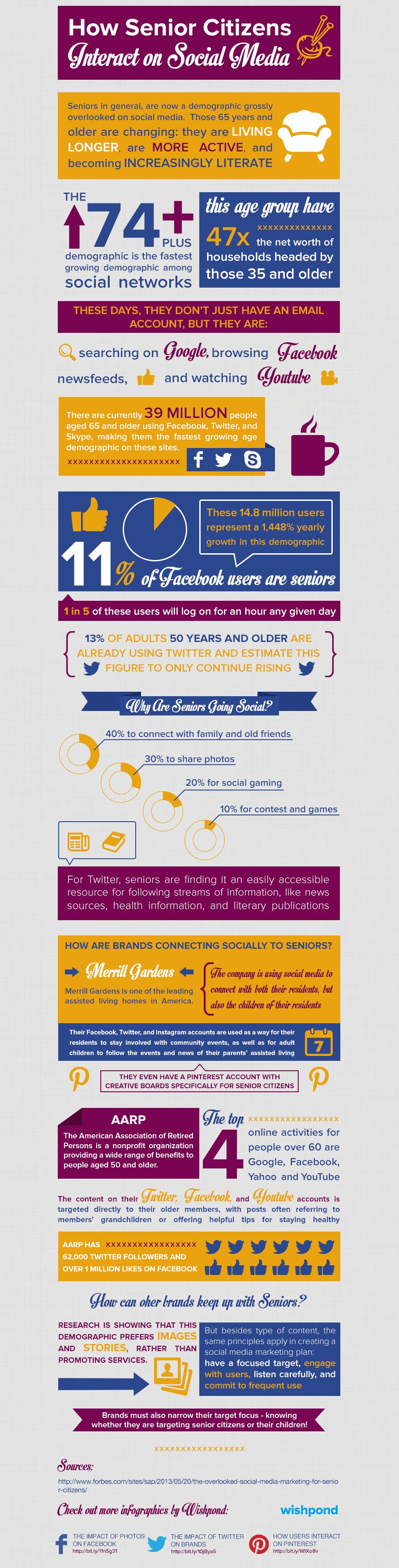
Not only does this age group have 47x the net worth of households headed by those 35 and older (according to AdAge), but they are now the fastest growing users of social media.  These days, they don’t just have an email account, but they are searching on Google GOOG +7.12%, browsing Facebook FB +2.94%newsfeeds, and watching YouTube—sometimes from their iPad.  According to thePew Research Center’s Internet & American Life Project, “the 74-plus demographic is the fastest growing demographic among social networks.”  There are currently 39 million people aged 65 and older using Facebook, Twitter, and Skype, making them the fastest growing age demographic on these sites.
While people are starting to notice more and more grandparents on their Facebook accounts, the figures are actually much greater.  According to an All Assisted Living Homes 2010 report, 11% of Facebook users are seniors.  These 14.8 million users represent a 1,448% yearly growth in this demographic.  More and more classes are being held to train senior citizens how to use online tools like Facebook, and 1 in 5 of these users will log on for an hour any given day.  The Pew Research found that 13% of adults 50 years and older are already using Twitter and estimate this figure to only continue rising.

How #Social #Media Keeps Seniors Healthy @SUN

JULIA LITTLE  |  JUNE 20, 2014

Seniors are flocking to social media sites at a rising pace, as networks like Facebook, Twitter and Instagram continue to post higher adoption rates among adults over the age of 65. While some older adults frequent these websites for purely social or entertainment reasons, a new study from the American Psychological Association found that participation in these sites can bolster cognitive health for seniors.
According to the Pew Research Internet Project, 59 percent of adults over the age of 65 are online. Specifically, 46 percent of seniors in this group are active on social media, creating and maintaining profiles on popular networks. Both numbers have continually risen over the years, with the source noting that only 33 percent of seniors used social media in 2011. 
As a greater number of older adults join these sites, researchers have discovered the benefits that arise following adoption.
Seniors receive social, mental and physical boost
The APA recently published a string of studies that illustrated how social media affected senior health, discovering that older adults who had positive social interactions on these sites reported elevated moods, while those who had negative experiences were more likely to have physical side effects. The organization added that seniors who participated in these sites and maintained strong connections with friends and loved ones reported fewer instances of negative health habits, such as smoking, depression or disease. 

[INFOGRAPHIC] How Senior Citizens Interact on #Social #Media


Did you know:  The 74+ demographic is the fastest growing among social networks.

As a marketer, its exciting to see new market segments flocking to social media. It allows for many new industries that target older age groups to use social media effectively. And there are already a few businesses that have capitalized on the growing trend, as you’ll see in the infographic below.
The following infographic shows how senior citizens are using social media and why it’s uber important to take their growing presence into account in your social media strategy.
If your interested in running a social media marketing campaign, check outWishpond's Social Campaign Apps
How do you use social media to target your specific customer market? Let us know in the comments.
image
By Nick Steeves @ Wishpond
Orignially posted on the Wishpond blog
